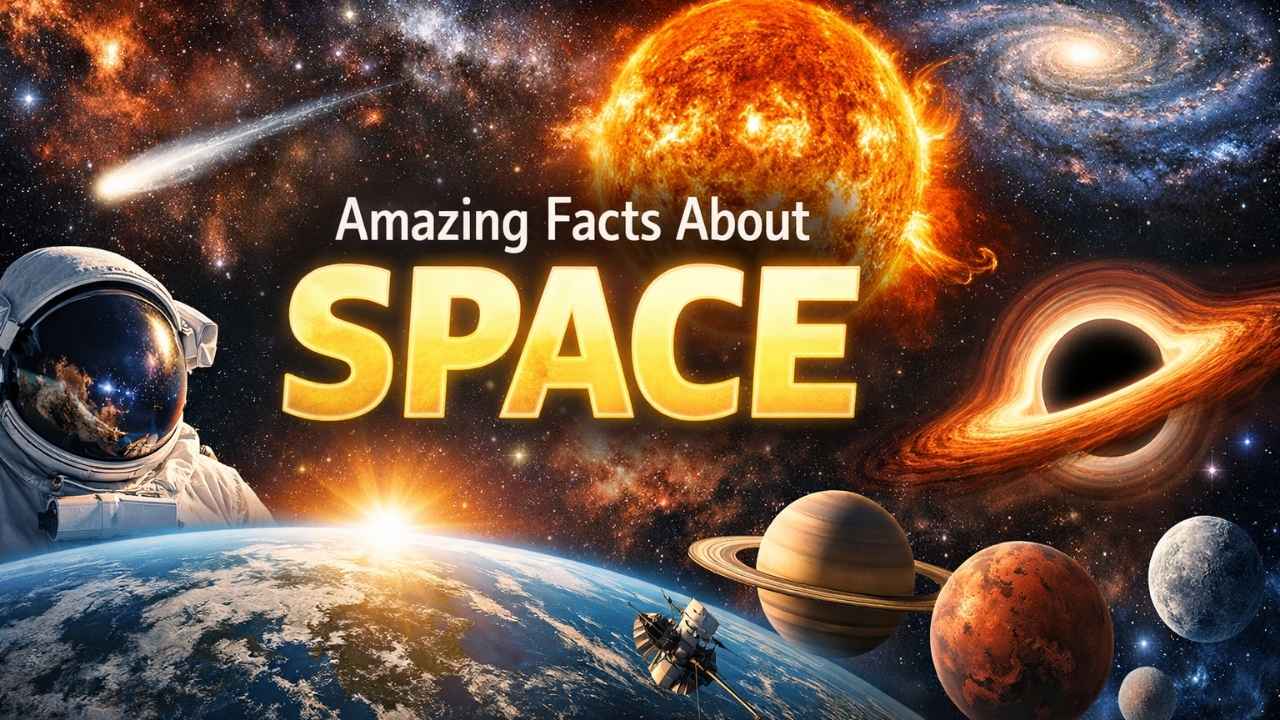
Space is an extremely vast region that begins beyond Earth’s atmosphere and continues for billions of light-years in every direction. Scientists estimate that the observable universe is about 13.8 billion years old, and it contains hundreds of billions of galaxies, each with billions of stars and planets. Modern astronomy uses telescopes, satellites, and space probes to study this enormous cosmic system.
The region closest to Earth is called outer space, where there is almost no air, no sound, and very little matter. Temperatures in space can range from extremely hot near stars to extremely cold in empty regions. The vacuum of space makes it a unique environment where the laws of physics on Earth do not apply.
Over the last century, space research has expanded rapidly through missions by organizations such as NASA, ESA, ISRO, and Roscosmos. Artificial satellites, space telescopes, and human spaceflight have helped scientists discover many surprising facts about planets, stars, black holes, and galaxies. The following sections explain some of the most interesting and scientifically proven facts about space.
The Size of the Universe Is Hard to Imagine
The universe is so large that distances are measured in light-years, which is the distance light travels in one year. Light moves at about 300,000 kilometers per second, meaning even nearby stars are extremely far from Earth.
Astronomers believe the observable universe has a diameter of about 93 billion light-years, even though it is 13.8 billion years old. This happens because space itself is expanding, making galaxies move farther apart over time.
There are more stars in the universe than grains of sand on Earth. Scientists estimate that the Milky Way galaxy alone contains 100–400 billion stars, and there are likely more than two trillion galaxies in the observable universe.
Table: Scale of Space Objects
| Object | Approximate Size / Distance |
|---|---|
| Earth diameter | 12,742 km |
| Distance to Moon | 384,400 km |
| Distance to Sun | 150 million km |
| One light-year | 9.46 trillion km |
| Milky Way diameter | ~100,000 light-years |
| Observable universe | ~93 billion light-years |
Space Is Completely Silent
Sound cannot travel through space because sound waves need a medium to move. Since space is mostly empty, there are no particles close enough to carry sound waves.
Astronauts in space cannot hear each other directly outside their spacecraft. They must use radio communication, which works through electromagnetic waves that can travel in a vacuum.
Even large cosmic events, such as exploding stars or colliding galaxies, do not produce sounds that humans can hear in space. However, scientists can convert electromagnetic signals into audio for study.
Key Facts About Space Vacuum
- Space has extremely low pressure
- There is almost no oxygen in space
- Temperatures change very quickly
- Heat transfer happens mainly through radiation
The Sun Contains Most of the Solar System’s Mass
The Sun is the largest object in our solar system and holds about 99.8% of the total mass of the entire system. Its strong gravity keeps planets, asteroids, and comets in orbit.
The Sun is a medium-sized star, but it is still about 109 times wider than Earth. More than one million Earths could fit inside the Sun.
Energy from the Sun is produced by nuclear fusion, in which hydrogen atoms fuse to form helium, releasing a huge amount of energy.
Black Holes Are One of the Most Powerful Objects in Space
Black holes form when very massive stars collapse under their own gravity. The gravity becomes so strong that even light cannot escape, which is why they appear black.
At the center of most galaxies, including the Milky Way, scientists believe there is a supermassive black hole. The one in our galaxy is called Sagittarius A* and has millions of times the mass of the Sun.
Black holes do not suck everything in like a vacuum cleaner. Objects must come very close to be pulled in by their gravity.
Table: Types of Black Holes
| Type | Description |
|---|---|
| Stellar black hole | Formed from collapsed stars |
| Intermediate black hole | Medium size, rare |
| Supermassive black hole | Found in galaxy centers |
| Primordial black hole | Theoretical, formed the early universe |
Planets in Our Solar System Have Extreme Conditions
Each planet has very different environments. Some are extremely hot, while others are freezing cold.
Mercury has very high daytime temperatures but becomes extremely cold at night because it has almost no atmosphere. Venus is hotter than Mercury because its thick atmosphere traps heat. Jupiter is the largest planet, while Saturn is known for its rings.
Mars is one of the most studied planets because scientists believe it once had water.
Important Facts About Planets
- Jupiter is the largest planet in the solar system
- Venus is the hottest planet
- Mars has the tallest volcano (Olympus Mons)
- Saturn has the most visible rings
- Neptune has the fastest winds
Space Travel Is Very Difficult and Expensive
Reaching space requires a very high speed. A spacecraft must travel about 28,000 km per hour to stay in orbit around Earth.
Astronauts experience microgravity, which makes them float inside a spacecraft. Long-term space travel affects muscles, bones, and the human heart.
Space agencies spend billions of dollars on missions because rockets, fuel, and technology are very complex. Human missions have reached the Moon, and robotic missions have explored Mars, Jupiter, Saturn, and beyond.
There May Be Billions of Habitable Planets
Scientists have discovered thousands of planets outside our solar system, called exoplanets. Some of them are located in the habitable zone, where liquid water could exist.
The Milky Way alone may contain billions of Earth-like planets. However, no confirmed evidence of life outside Earth has been found yet.
Space telescopes such as Hubble and James Webb help scientists study distant planets and galaxies.